
They Are Someone, Not Something
The Scale
A Number Almost Too Large to Picture
Each year, the global meat, dairy, egg and fishing industries kill an estimated 83 billion land animals and somewhere between 1 trillion and 2.7 trillion aquatic animals. To put that in human terms: every two seconds, more land animals are killed than the entire population of New York City. Every twenty-four hours, the death toll exceeds the total number of humans who have ever lived.
Numbers at this scale stop functioning as numbers. We cannot picture them. But behind each one is something the statistics flatten out — an individual life. A piglet who recognised her mother's voice. A hen who chose the same corner of the shed every night. A calf who, in her last hour, was still looking for the herd. The point of writing about animals is to put the individuals back into the arithmetic.

We say a chicken is a thing. We mean: please don't make us look.
Sentience
They Feel — and We've Known for a Long Time
In 2012, an international group of leading neuroscientists signed The Cambridge Declaration on Consciousness, formally concluding that non-human animals — including all mammals and birds, and many other creatures including octopuses — possess the neurological substrates that generate consciousness. Translated out of academic language: they are conscious beings. They have inner lives.
The behavioural evidence is even older and broader. Pigs solve mirror tests and outscore three-year-old children on simple problem-solving tasks. Hens display empathic distress when their chicks experience discomfort. Cows form close, lasting friendships and grieve when separated. Fish use tools, learn from each other, and pass on local cultures. Even insects, recent work suggests, may experience something like negative affect.
We do not need to settle every philosophical question about animal minds to act on what we already know. We treat humans as deserving of moral consideration on the basis of their capacity to suffer and to flourish. The same capacities exist, in different shapes, in the animals we eat.

“The convergent evidence indicates that non-human animals have the neuroanatomical, neurochemical, and neurophysiological substrates of conscious states along with the capacity to exhibit intentional behaviours.”
Inside the Sheds
What Standard Practice Actually Looks Like
The footage that follows is not from rogue operators. It is standard practice inside legal, certified facilities in wealthy countries. We share it not to shock, but because the food industry has spent decades persuading us that this is somewhere else, somewhere worse, somewhere we don't need to think about.

The Three Cruelties
What Industrial Animal Agriculture Does to a Body

Confinement
A standard egg-laying hen lives her entire adult life in a space smaller than an A4 sheet of paper. A breeding sow may spend years in a stall the length of her own body. Movement, light, air, dignity — all designed out of the system.
Mutilation Without Anaesthesia
Beak-trimming in chicks. Tail-docking and teeth-clipping in piglets. Disbudding in dairy calves. Castration in lambs. These are routine, performed without pain relief, on babies, in their billions.
Genetic Distortion
Modern chickens reach slaughter weight in 35 days — three times faster than 50 years ago — leaving their hearts and skeletons unable to keep up. Dairy cows produce ten times more milk than nature ever asked of them. We have engineered animals against their own bodies.
None of these practices is illegal. All are normal. The horror of factory farming is not that it breaks the rules but that the rules are designed around it. Welfare regulations in most countries explicitly exempt routine agricultural practices from the standards that would apply to any pet.

The Animals
Who Lives Inside the Numbers


Chickens
At any moment, ~25 billion chickens are alive on Earth — three times the human population. The vast majority will never see daylight. Broilers are killed at 5–7 weeks. Layer hens are killed at 18 months when egg production drops.
Cattle
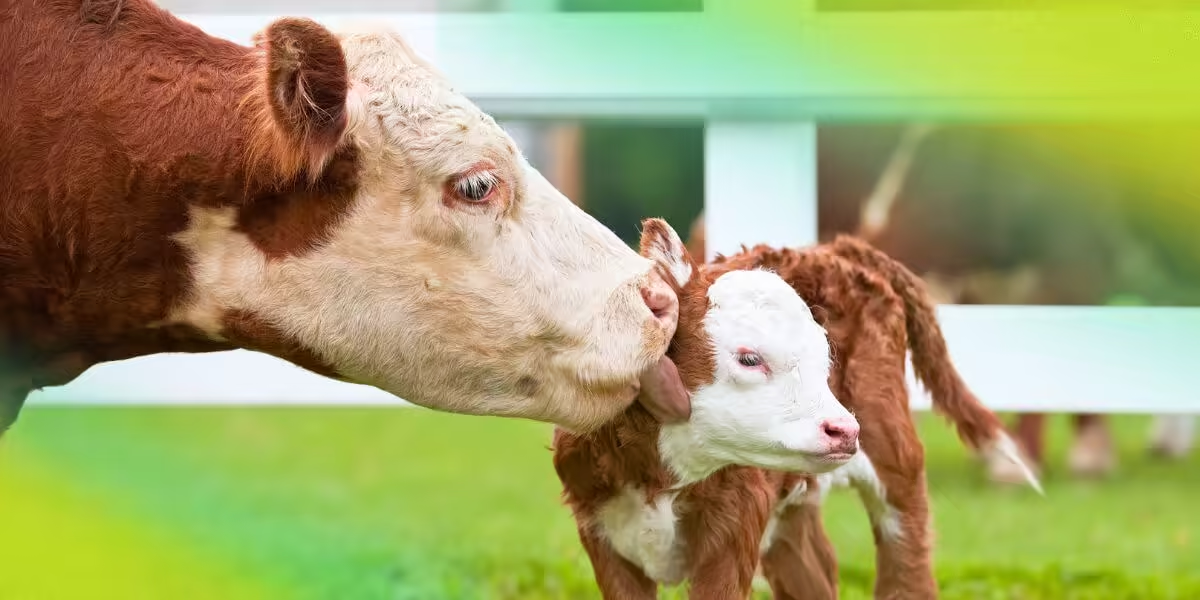
Around 300 million cattle are slaughtered annually for beef. Dairy cows are forcibly impregnated each year; their calves are removed within hours so the milk meant for them can be sold. Male calves typically become veal.
Pigs
More than 1.4 billion pigs are killed each year — among the most cognitively complex animals on the planet. They recognise themselves in mirrors, dream during REM sleep, and form lasting bonds. They are slaughtered at 6 months.
Ducks & Geese
Foie gras production force-feeds birds via metal pipes until their livers swell to ten times normal size. Even outside foie gras, duck and goose farms confine flocks denied access to the water their bodies are built around.
Sheep & Lambs
Lambs are slaughtered between 4 and 12 months. In wool production, mulesing — cutting flesh from a live lamb's hindquarters without anaesthesia — remains widespread in major exporting countries.
Aquatic Animals
Fish are crushed under their own weight in nets, suffocated on decks, or have ice slurry poured over them while still conscious. There are no welfare laws governing their slaughter — anywhere on Earth, in any country.


The Sea
The Largest Hidden Slaughter on Earth
Land animals dominate the conversation, but the ocean is the larger ledger. Estimates of the number of fish killed each year for human consumption range from one to nearly three trillion — a number so staggering it has its own measurement problem. We don't count fish; we weigh them.
Wild-capture fishing has emptied the seas. According to the FAO, over a third of global fish stocks are now fished beyond sustainable levels, and many fisheries are projected to collapse within a generation. For every kilogram of shrimp pulled from a trawl, up to 20 kilograms of bycatch — turtles, dolphins, sharks, seabirds, juvenile fish — are killed and discarded.
Aquaculture is no kinder. Farmed salmon live in floating cages packed at densities equivalent to keeping a 30-pound dog in a bathtub for life. Sea lice infestations are constant. Mortality rates of 25% before harvest are considered acceptable.

The state of the world's seas
Beyond Food
The Industries That Quietly Use Animals Too
A plant-based ethic doesn't stop at the dinner plate. The same disregard that turns animals into meat turns them into other commodities — leather, wool, fur, silk, down, ingredients in cosmetics, subjects of laboratory experiments. Some of these industries are larger than you'd think. Most are invisible by design.

Animal Testing
An estimated 192 million animals are used in laboratory experiments each year worldwide — for cosmetics, medicines, household products, and military research. Modern in-vitro and AI alternatives often outperform animal models, yet remain underused.
Fur, Leather, Wool
100 million animals are killed for fur each year. Leather is not a 'by-product' — for cattle, hide value alone is up to 10% of an animal's market price, directly subsidising slaughter. Wool industries routinely involve mulesing, live export, and slaughter at the end of useful production.
Entertainment
From greyhound racing to circuses to live-bird shooting events, animals are still used as props for human spectacle. Many of these industries are quietly being phased out — usually by public pressure rather than regulation.
The Wildlife Trade
The global wildlife trade — much of it legal — supplies pets, traditional medicine, and exotic foods, and is a leading driver of zoonotic disease emergence. SARS, MERS, and COVID-19 all have origins entangled with wildlife exploitation.
Voices
Why Thinkers Across Centuries Have Spoken Up
“The greatness of a nation and its moral progress can be judged by the way its animals are treated.”
“If a man aspires towards a righteous life, his first act of abstinence is from injury to animals.”
“There will come a time when the world will look upon modern vivisection in the name of science as they now look upon vivisection in the name of religion.”
Common Questions
What People Most Often Ask
What about humane farming and high-welfare labels?
What about fish — they don't really feel pain, do they?
Aren't humans designed to eat meat?
If everyone went vegan, what would happen to all the farm animals?
Key takeaways
Sentience is settled science
The Cambridge Declaration on Consciousness (2012) confirmed that mammals, birds and octopuses possess the neurological substrates of conscious experience. The debate is no longer whether they feel.
Cruelty is legal, not exceptional
Most of what shocks people in undercover footage is standard, lawful practice: gestation crates, battery-style cages, debeaking, castration and tail-docking without anaesthesia.
Fish are the largest ledger
Between 1 and 2 trillion aquatic animals are killed each year. No country has slaughter welfare laws that meaningfully cover them.
Demand drives breeding
Farmed animals exist because they are ordered into existence. Falling demand means fewer animals bred, not billions released — the change happens upstream.
Sources & further reading
- Cambridge Declaration on Consciousness (2012) — Signed by leading neuroscientists at the University of Cambridge
- FAO Statistical Yearbook (FAOSTAT) — Global slaughter and production figures
- Mood & Brooke, fishcount.org.uk — Estimates of wild-caught and farmed fish numbers
- EFSA welfare opinions on pigs, laying hens and broilers — EU scientific assessments of standard husbandry practices
- Marino & Colvin, Int. Journal of Comparative Psychology — Cognition and emotion in domestic pigs
Take the Next Step
What You Do Next Matters Most
Reading about animals can leave you carrying weight you don't quite know what to do with. The simplest thing to do is the most powerful: change what you eat. Not all at once, not perfectly — just honestly, in the direction of less harm. Every meal you choose plant-based is one fewer order placed with the system above. Multiplied across a lifetime, it adds up to roughly 200 land animals, and many thousands of fish, who never had to enter it.
Investigations
Voices from the Field
Footage from frontline animal-protection organizations. Watch what the industry doesn't show.
Source: PETA
Source: Mercy For Animals