
Four Reasons. One Direction.
The First Pillar
For the Animals
More than 80 billion land animals and over a trillion fish are killed for food each year. The vast majority live and die inside an industrial system that bears no resemblance to the pastoral imagery on the packaging. They are confined, mutilated without anaesthesia, and bred to grow at speeds that injure their own bodies.
We do not need to settle every philosophical question about animal minds to act on what we already know: they feel. The Cambridge Declaration on Consciousness, signed by leading neuroscientists in 2012, formally recognised that mammals, birds, and many other animals possess the substrates of consciousness. They have inner lives. They prefer pleasure to pain. They want to live.
Choosing plants is the simplest, most direct way to withdraw consent from a system most of us would never approve of in person. One person eating plant-based for a year spares roughly 200 land animals and many thousands of fish. Across a lifetime, that is a small herd's worth of beings who never had to enter the slaughterhouse — because of you.
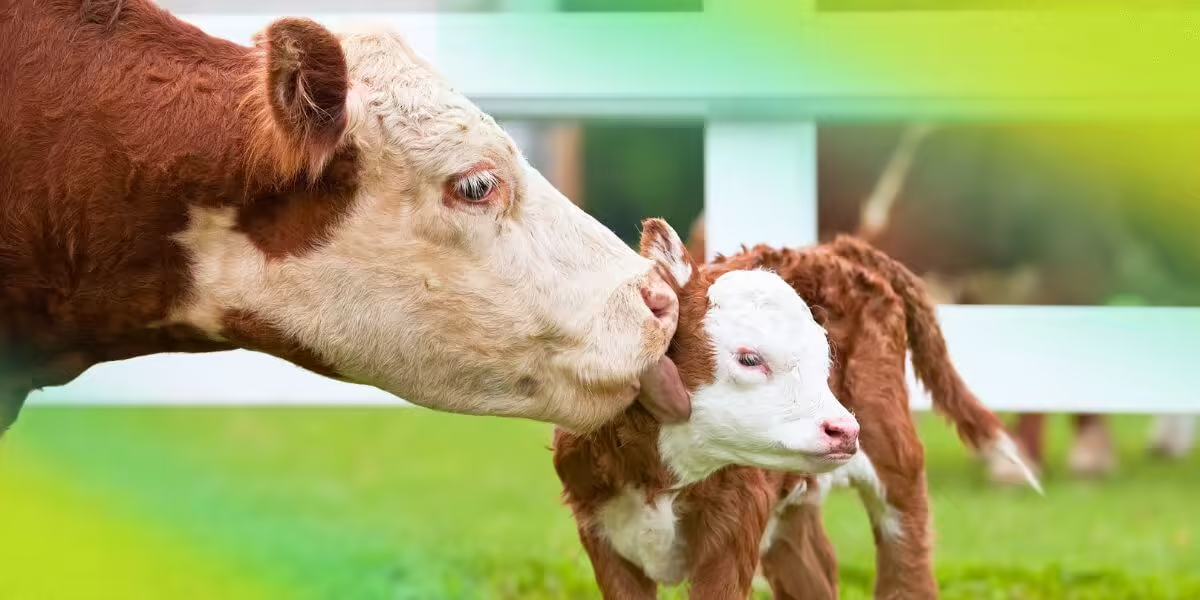

The question is not, can they reason, nor can they talk, but: can they suffer?
The Second Pillar
For the Planet
Animal agriculture is the largest single human use of land on Earth, the biggest driver of deforestation, the leading polluter of fresh water, and a major contributor to climate emissions. The 2018 Oxford meta-study — covering 38,700 farms in 119 countries — concluded that moving to a plant-based diet was the single biggest action an individual can take to reduce their environmental impact.
Specifically: a vegan diet uses 76% less land, generates 49% fewer food-related emissions, and consumes dramatically less fresh water than a typical Western diet. Even cutting beef and lamb alone — without going fully plant-based — delivers the largest single climate gain available at the dinner table.

The environmental case, summarised
The Third Pillar
For Your Health
The largest nutritional studies in human history all point in the same direction. Vegans tend to have lower body weight, lower blood pressure, lower LDL cholesterol, lower fasting blood sugar, and lower rates of heart disease, type 2 diabetes, and several cancers. The American Dietetic Association formally endorses well-planned vegan diets at every life stage.
This isn't restrictive eating; it's expansive eating. Most people on a standard Western diet are eating fewer than 12 grams of fibre a day, well below the 30g+ that protects against colorectal cancer, heart disease, and insulin resistance. Plant-based diets typically deliver 40–60g of fibre without thinking about it. The microbiome flourishes. Energy stabilises. Inflammation cools.


The Fourth Pillar
For Each Other
A third of the world's grain harvest is grown to feed farmed animals. If those calories were directed at humans instead, they could feed an estimated 3.5 billion additional people — roughly the number who currently struggle to afford a healthy diet. The inefficiency of the animal-based food system is, quietly, one of the largest forms of waste on the planet.
Beyond hunger: industrial animal agriculture concentrates pollution in poor and rural communities, exposes slaughterhouse workers to some of the highest workplace injury rates in any industry, and consumes 73% of all antibiotics sold worldwide — driving the antimicrobial resistance crisis that the WHO calls one of the top global public-health threats of our era. The food choices of wealthy consumers are written, in chemicals and contracts, into the lives of people they will never meet.

Watch
The Case in Voices, Not Just Numbers

The Path
A Map for the First 30 Days
The best-laid plant-based start is, almost always, the simplest. You don't need to overhaul your kitchen. You need a small handful of new habits that slot into the life you already have.

Week 1
Notice what's already plant-based
Pasta with tomato sauce, peanut-butter toast, lentil soup, vegetable stir-fries, bean tacos. Most people are surprised to find they already eat plant-based several times a week without thinking about it.
Week 2
Swap your staples
Oat or soy milk in coffee. Olive oil instead of butter. Hummus and avocado instead of cheese in sandwiches. Tofu, lentils, chickpeas, or seitan as your protein anchor. Stock the freezer with edamame and frozen berries.
Week 3
Learn three dinners
A creamy chickpea curry. A smoky black-bean chilli. A stir-fried tofu with greens. Repeat them until they feel easy. Add overnight oats for breakfast. That's the whole rotation.
Week 4
Handle the social stuff
Read menus before you go out. Tell hosts in advance. Find a YouTube cook you actually enjoy. Take a daily B12 supplement. Notice how you feel — physically and ethically. That's the new baseline.
Calculate
What Your Decision Adds Up To
Calculate Your Impact
Slide to see what eating plant-based for a chosen number of days actually saves.
Upper-bound estimates from Poore & Nemecek (Science, 2018; 38,700 farms, 119 countries), Mekonnen & Hoekstra (water footprints), and Counting Animals (incl. aquatic).
Voices
Why So Many Have Already Made the Move
“I'm going on six years of being vegan now, and I think it's the secret to my longevity. Recovery, sleep, energy — everything is better.”
“The best decision I made was changing my diet to plant-based — for performance, for recovery, and for the rest of my life.”
“To my mind, the life of a lamb is no less precious than that of a human being.”
Common Questions
What People Most Often Ask Before Starting
Do I have to be perfect?
Will my family hate this?
Do I have to give up my favourite foods forever?
What if I slip up?
Begin
One Honest Step, Today
You don't need to know everything before you begin. You need a single plant-based meal — tonight, or tomorrow — and the willingness to make another one after that. Compassion isn't a destination. It's a direction.
Watch
The Case in Two Voices
One narrated by Paul McCartney, one from the world of medicine. Same conclusion.
Source: PETA
Source: Forks Over Knives