
nutrition
The White Revolution Reconsidered: Why the Global North is Rethinking the Cow
As shifting dietary patterns collide with climate imperatives, we examine the biology, ecology, and ethics behind our ancient relationship with milk.
Published June 16, 2026 · 7 min read
Image: Carol VanHook from Iowa, USA · CC BY-SA 2.0 · Wikimedia Commons · source
For decades, dairy was positioned as a non-negotiable pillar of metabolic health. New longitudinal data and environmental modeling are now challenging that status, revealing a complex picture of evolutionary adaptation and resource intensity.
In the cool, antiseptic aisles of the modern supermarket, milk is often presented as a neutral baseline of human nutrition. It is the first food many of us ever knew, a symbol of growth, and a staple of civilizational development. Yet, if we step back from the refrigerated shelves and look at the biological and ecological ledger, the story of dairy becomes one of the most complex and contested narratives in modern science. The 'White Revolution'—the mid-20th-century push for industrial milk production—is currently facing a reckoning, driven by breakthroughs in genomic research and the urgent math of planetary boundaries.
To understand dairy today, we must first understand our peculiar history with it. Human beings are the only species that consumes the milk of another species, and notably, the only species that continues to consume milk into adulthood. This is a biological anomaly. For roughly 65% of the global population, the ability to digest lactose—the primary sugar in milk—shuts down after weaning. This condition, known as lactose malabsorption, is not a disorder; it is the ancestral human default. Only through a relatively recent evolutionary process called lactase persistence did certain populations, primarily in Europe and parts of Africa and the Middle East, develop a genetic mutation allowing them to process dairy throughout their lives. This evolutionary 'fast-track' occurred because, in specific historical contexts, the calories and nutrients in milk provided a survival advantage during crop failures.
The Nutritional Pivot
For nearly a century, public health guidelines in the United States and Europe have categorized dairy as an essential food group. The primary argument has centered on calcium and bone density. However, recent evidence is complicating the 'more is better' mantra. A landmark 2020 review published in the *New England Journal of Medicine* by Dr. Walter Willett and Dr. David Ludwig of Harvard University argued that the evidence for high milk consumption preventing bone fractures is surprisingly thin. Their analysis suggested that countries with the highest dairy consumption often have the highest rates of hip fractures, a phenomenon known as the 'calcium paradox.'
While milk is undeniably nutrient-dense—providing Vitamin D, protein, and potassium—modern nutritional science is looking at the 'package' these nutrients come in. When we consume whole milk, we are also consuming significant amounts of saturated fat. While the debate over saturated fat and cardiovascular health continues, the *Journal of the American College of Cardiology* has noted that replacing dairy fats with polyunsaturated fats from nuts or seeds significantly lowers heart disease risk. This suggests that while dairy is not necessarily 'poison,' it may not be the optimal source of the nutrients it provides.
The Ecological Footprint
Perhaps the most pressing critique of modern dairy comes not from the lab, but from the land. The scale of global dairy production has ballooned to meet the demands of nearly 8 billion people. According to the comprehensive 2018 study by Joseph Poore and Thomas Nemecek of the University of Oxford, published in *Science*, the environmental impact of one glass of dairy milk is vastly greater than that of any plant-based alternative.
- Land Use: Producing a single liter of dairy milk requires nearly nine times more land than producing a liter of soy or oat milk. This occupies vast tracts of land that could otherwise be used for carbon sequestration or biodiversity restoration.
- Water Consumption: Dairy is an incredibly thirsty industry. A liter of cow's milk requires approximately 628 liters of water, compared to just 48 liters for soy milk.
- Greenhouse Gases: The dairy sector is a major contributor to methane emissions, a potent greenhouse gas with a warming potential over 80 times that of CO2 over a 20-year period. Ruminant digestion (enteric fermentation) and manure management are the primary culprits.
"The dairy industry is no longer just a collection of family farms; it is a global thermodynamic system that converts massive amounts of grain and water into a liquid that a majority of the world's population cannot fully digest."
The Welfare of the Modern Cow
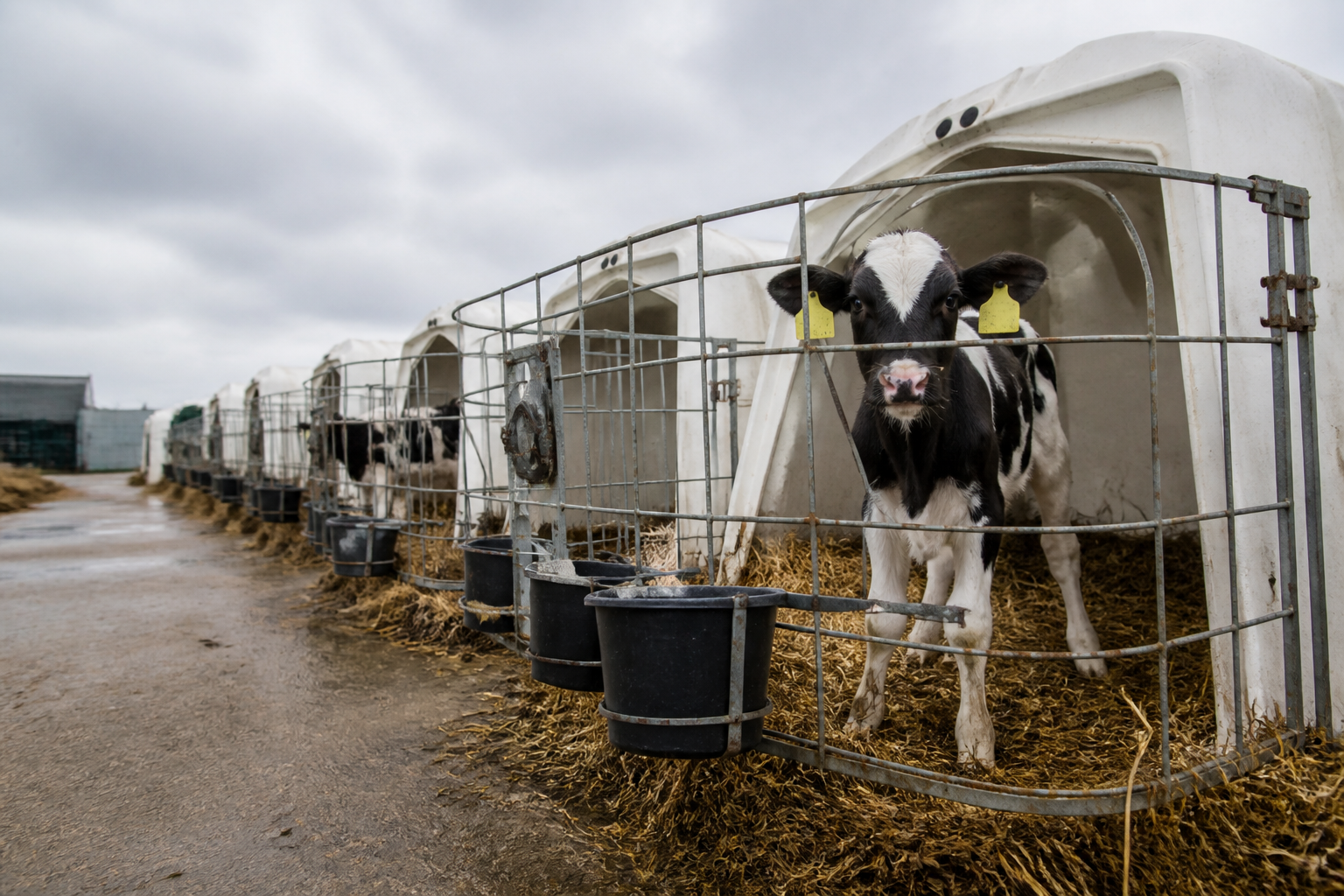
To maintain the high yields required for global supply chains, the biological reality of the cow has been pushed to its limits. A cow must be pregnant or have recently given birth to produce milk. In industrial systems, this results in a cycle of annual artificial insemination. The most sensitive point in this cycle is the separation of the calf from the mother, which typically occurs within hours of birth to ensure the milk can be collected for human consumption.
Male calves, being of no use to the dairy industry, are often diverted to the veal industry or killed at birth. Female calves are raised to replace their mothers in the milking line. This cycle has drawn increasing scrutiny from animal welfare organizations like *Compassion in World Farming*, which points out that while physical health markers (like yield) may be high, the behavioral and psychological needs of these social, intelligent animals are rarely met in zero-grazing, intensive systems.
The Rise of the Alternatives
We are currently witnessing a diversification of the 'milk' category that would have been unthinkable twenty years ago. The rise of oat, soy, almond, and hemp milks is not merely a culinary trend; it is a structural shift in how we perceive liquid nutrition. From a health perspective, fortified soy milk is cited by the *2020-2025 Dietary Guidelines for Americans* as the only plant-based alternative nutritionally comparable to cow's milk.
However, the future may not just be plant-based. Precision fermentation—a process where microbes are engineered to produce real whey and casein proteins without the cow—is moving from the laboratory to the market. Companies like Perfect Day are already producing dairy proteins that are molecularly identical to those from a cow but require a fraction of the land and water. This 'animal-free dairy' represents a potential middle ground: the functionality and taste of dairy without the methane or the ethical burden.
Reimagining the Future
As we look ahead, the 'truth' about dairy is that it is shifting from a mandatory staple to an optional luxury. For many in the Global North, the transition away from daily dairy consumption is a low-hanging fruit for personal health and planetary stability. This does not mean the immediate end of the dairy farm, but it does necessitate a transition toward higher-welfare, lower-intensity systems where the cow is part of a regenerative landscape rather than a cog in a high-throughput factory.
We are moving toward a more nuanced understanding of our diets. The evidence suggests that while dairy helped certain human populations survive the harsh winters of the past, it is no longer a requirement for a thriving future. By embracing a wider variety of plant-based and technologically advanced alternatives, we can nourish a growing population while respecting both our biological limits and the boundaries of the planet we call home.
The Methane Paradox and Methane Mitigation Technologies
Methane (CH4) produced by dairy cattle is a short-lived climate pollutant with a warming potential 84 times greater than carbon dioxide over a 20-year horizon. According to the Global Methane Assessment (2021), the livestock sector accounts for approximately 32% of human-caused methane emissions, primarily through enteric fermentation and manure management. While carbon dioxide lingers for centuries, methane degrades in roughly a decade, meaning rapid reductions in dairy production could provide an immediate 'cooling' effect on the global temperature.
To address this, the industry is exploring several methane mitigation technologies: * 3-NOP (Bovaer): A feed additive that can reduce enteric methane emissions by approximately 30% in dairy cows, according to a 2022 study published in *Nature Communications*. * Red Seaweed (Asparagopsis taxiformis): Research from UC Davis (2021) suggests that incorporating this seaweed into feed can reduce methane by up to 82%, though scalability remains a challenge. * Manure Digesters: Systems that capture methane from waste to produce biogas, though critics argue these incentivize larger, more polluting CAFOs (Concentrated Animal Feeding Operations).
Despite these innovations, the UN Environment Programme (2023) emphasizes that technological fixes alone are insufficient to meet the 1.5°C Paris Agreement target without a concurrent reduction in total livestock numbers.

Precision Fermentation and the Cellular Dairy Revolution
Precision fermentation is a biotechnology process that uses genetically programmed microorganisms—such as yeast or fungi—to produce bio-identical dairy proteins like whey and casein without animal involvement. According to a report by RethinkX (2020), this 'cellular agriculture' could make the traditional dairy industry obsolete by 2030 by producing proteins that are functionally identical but require 90% less land and 100 times less water.
Unlike plant-based milks, which often struggle with texture and 'meltability,' fermentation-derived dairy offers: 1. Molecular Identity: The proteins are chemically identical to those found in bovine milk, allowing for the creation of cheese that stretches and melts naturally. 2. Allergen Control: Companies like Perfect Day can produce lactose-free and cholesterol-free dairy, addressing the 65% of the global population with lactose malabsorption. 3. Efficiency: The Good Food Institute (2023) notes that these 'microbial factories' operate with a significantly higher feed-conversion ratio than a living cow, which must expend energy on metabolism and bone growth.
As of 2024, regulatory approvals in the US, Singapore, and Israel have allowed these products to enter the market, signaling a shift from farm-based to lab-based dairy supply chains.
<!-- one-fork:related-links -->
Further Research and Impact Tools
<!-- /one-fork:related-links -->
FAQ
- What is the 'Calcium Paradox' in dairy nutrition?
- The calcium paradox refers to the observation that countries with the highest dairy consumption and calcium intake, such as Sweden and the US, also report the highest rates of hip fractures. A 2020 review in the *New England Journal of Medicine* suggests high milk intake does not necessarily lower fracture risk.
- How does dairy farming contribute to antibiotic resistance?
- Dairy farming often uses antibiotics for disease prevention and growth promotion. According to the **World Health Organization (WHO)**, the overuse of antimicrobials in livestock is a primary driver of antibiotic-resistant 'superbugs,' which cause an estimated 1.27 million human deaths annually as of 2019.
- Is soy milk a nutritionally complete substitute for cow's milk?
- Yes, according to the **USDA Dietary Guidelines for Americans (2020-2025)**, fortified soy milk is the only plant-based beverage categorized as nutritionally equivalent to dairy milk, providing similar levels of protein, Vitamin A, and Vitamin D.
Sources
- Milk and Health by Walter C. Willett and David S. Ludwig — New England Journal of Medicine
- Reducing food’s environmental impacts through producers and consumers — Science (Poore & Nemecek)
- Dairy and climate change — Food and Agriculture Organization of the United Nations
- Dairy and Health: The Evidence for a Plant-Based Diet — The Lancet Planetary Health
- Milk and Health: Review by Willett and Ludwig — New England Journal of Medicine
- Global Methane Assessment 2021 — United Nations Environment Programme
- Precision Fermentation: The Future of Food — The Good Food Institute
- Dietary Guidelines for Americans 2020-2025 — U.S. Department of Agriculture