Is soy safe? Doesn't it cause hormone problems?
HEALTH
Short answer
Yes, soy is safe. Isoflavones bind weakly to estrogen receptors but do not mimic human estrogen; large studies show soy reduces breast cancer risk.
HEALTH
The detail
Soy isoflavones are phytoestrogens with a chemical structure similar to human estrogen but with roughly 1/1000 the activity, and they preferentially bind the beta receptor rather than alpha. Meta-analyses of over 300 000 women show soy consumption is associated with reduced breast cancer risk and better outcomes in survivors.
Men can safely eat 1–2 servings/day; multiple meta-analyses show no effect on testosterone, sperm quality, or feminisation. Whole soy (tofu, tempeh, edamame, soy milk) is the best form.
Source: American Institute for Cancer Research, 2021; Reed KE et al., Reprod Toxicol 2021
In depth
The longer answer
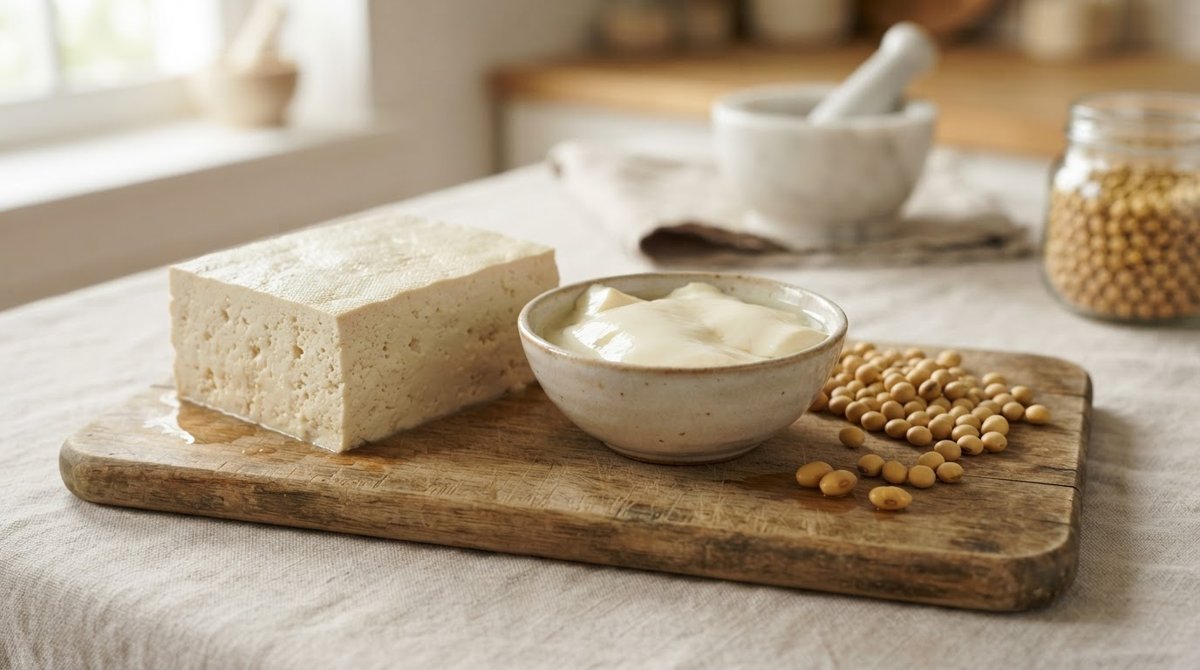
For most people, yes. Soybeans have been eaten for centuries in East Asia, and whole soy foods such as tofu, tempeh, edamame and soy milk provide complete protein, fibre, healthy fats and — in calcium-set tofu and fortified soy milk — calcium. The main worry people raise is isoflavones: plant compounds shaped a little like oestrogen that act much more weakly, and differently, in the body.
Fears about men's hormones are not supported by the evidence. An expanded 2021 meta-analysis of clinical studies in Reproductive Toxicology found that neither soy nor isoflavone intake affected testosterone, oestrogen or other male reproductive hormones. For women, the American Institute for Cancer Research states that soy foods are safe, including for breast cancer survivors, and studies in Asian populations link moderate soy intake with a lower risk of breast cancer.
A few cautions apply. Soy is a common allergen. People taking levothyroxine for an underactive thyroid should leave a few hours between the tablet and soy foods, because soy can reduce absorption, and should make sure they get enough iodine. Concentrated isoflavone supplements are different from soy foods and are not needed.
At a glance
Quick facts
- Is soy safe?
- Yes, for most people, as whole soy foods.
- Effect on men's testosterone
- None found (expanded meta-analysis, 2021).
- Breast cancer
- AICR: soy foods are safe and do not raise risk.
- Protein quality
- Soy is a complete protein with all essential amino acids.
- Who should take care
- People with soy allergy; people on thyroid medication (separate the timing).
- Best forms
- Tofu, tempeh, edamame, soy milk and miso.
| Detail | What to know |
|---|---|
| Is soy safe? | Yes, for most people, as whole soy foods. |
| Effect on men's testosterone | None found (expanded meta-analysis, 2021). |
| Breast cancer | AICR: soy foods are safe and do not raise risk. |
| Protein quality | Soy is a complete protein with all essential amino acids. |
| Who should take care | People with soy allergy; people on thyroid medication (separate the timing). |
| Best forms | Tofu, tempeh, edamame, soy milk and miso. |
In practice
What this means for you
- Choose minimally processed soy: tofu, tempeh, edamame, soy milk and miso.
- Pick calcium-set tofu (calcium sulphate on the label) for extra calcium.
- If you take thyroid medication, take it on an empty stomach and eat soy a few hours later.
- Skip isoflavone supplements unless a doctor recommends them — the research supports whole foods.
FAQ
Common questions
Does soy lower testosterone?
Is soy bad for women or for breast cancer?
Does soy affect the thyroid?
Is most soy grown for tofu?
Is genetically modified soy a concern?
RELATED
More questions like this
- Where do vegans get protein?
From legumes, tofu, tempeh, seitan, whole grains, nuts and seeds. Most vegans easily meet or exceed the daily requirement.
- Why don't vegans drink milk?
Dairy cows are repeatedly impregnated and separated from their calves, and most humans lose the ability to digest lactose after infancy.
Newsletter
One short letter. Once a month.
A handful of recipes, a story worth your time, and one thing you can do this week. Nothing else.
We never share your email. Unsubscribe in one click.