Quaker (Religious Society of Friends)
Overview
Quaker (Religious Society of Friends) — and the animals
The Religious Society of Friends, or Quakers, have a long-standing history of seeking peace and equality. This commitment to nonviolence and the recognition of 'That of God' in everyone naturally extends to our relationship with all sentient beings. Early Friends like John Woolman and Anthony Benezet recognized that the flame of life kindled by the Creator exists in all sensitive creatures, making cruelty a contradiction to the love of God.
Modern Quakerism continues this tradition by exploring the interconnectedness of all life. As we endeavor to open ourselves to the Spirit, we find that true understanding leads to compassion and loving action. This realization often manifests at the table, where the choice to abstain from animal products becomes a testimony to the sweetness of life and the kinship we share with our fellow creatures.
By adopting a plant-based diet, Friends honor the Quaker testimonies of Peace, Simplicity, and Integrity. It is an invitation to enlarge our circle of love, recognizing that what we do to the least of these creatures, we do to the Divine in whom all living beings move and have their being.
Principles
Teachings that point towards the plate
Universal Lovingkindness
The Quaker faith teaches that the flame of life is kindled in all animal and sensitive creatures by the breath of God. To exercise cruelty toward any creature while claiming to love the unseen God is considered a spiritual contradiction.
Kinship with Animals
Friends recognize a deep kinship with animals, viewing them not as objects for use but as fellow creatures. This sense of relationship leads to a natural opposition to practices like vivisection and the consumption of animal flesh.
The Peace Testimony
Quakerism emphasizes walking cheerfully over the world and answering to 'That of God' in every one. Extending this peace to animals involves rejecting the violence inherent in the factory farming system and hunting.
Interconnectedness
True understanding of the Spirit reveals the interconnectedness of all things. This spiritual relationship demands that our compassion does not end when we sit down to eat, but rather informs every meal.
Harmlessness
A central ideal in Quaker advocacy is harmlessness toward all living things. This involves a conscious effort to live in a way that minimizes suffering and honors the sweetness of life in all beings.
Integrity and Seeing Clearly
Failure to see things as they really are leads to suffering. Friends are called to witness the reality of animal treatment and align their actions with the truth of their compassion.
““To say we love God as unseen, and at the same time exercise cruelty toward the least creature moving by his life... was a contradiction in itself.””
““I considered that life is sweet in all living creatures, and taking it away became a very tender point with me.””
““What, would you have me eat my neighbor?””
““A true understanding of that relationship cannot end when we sit down at the table.””
““What we do to the hen we do to God, in whom all we chickens and humans and others live and move and have our being.””
““I felt a great yearning of heart toward my fellow creatures and much tenderness and compassion for the brute creation.””
In practice
Historical Roots of Quaker Compassion
The seeds of animal advocacy were planted early in the Society of Friends. John Woolman, famous for his opposition to slavery, also wrote extensively about the tenderness he felt for animals. He believed that a mind governed by Divine Love could not find pleasure in the suffering of any creature.
Other historical figures like Anthony Benezet and Elizabeth Collins carried this torch. Benezet famously referred to poultry as his 'neighbor,' refusing to eat them. These early Friends saw the exploitation of animals as a departure from the humble and tender spirit required of a follower of the 'Most High.'
In practice
Modern Quaker Activism
In the 19th and 20th centuries, Quakers were at the forefront of organized animal protection. Joseph Storrs Fry II and others founded the Friends’ Anti-Vivisection Association (now Quaker Concern for Animals) in 1891 to seek justice for animals.
Quaker women have also played pivotal roles. Anna Sewell used literature to improve the treatment of horses, while Ruth Harrison’s research into 'animal machines' alerted the world to the horrors of factory farming. Today, Friends continue this work through education, school presentations, and international campaigns.
In practice
The Testimony of Simplicity and the Environment
Choosing a vegan lifestyle is a modern expression of the Testimony of Simplicity. It reduces the ecological footprint and addresses social justice issues related to food distribution and planetary health.
By urging Meetings to buy animal-friendly supplies and encouraging Meatless Mondays, Friends practice stewardship of the Earth. This holistic approach recognizes that the suffering of animals, the destruction of the planet, and human health are all deeply linked.
In practice
The Contradiction of Cruelty
Early Friends like John Woolman recognized that the 'flame of life' kindled in all sensitive creatures is a direct expression of the Divine. Woolman argued that claiming to love an unseen God while exercising cruelty toward the 'least creature' moving by His life was a fundamental contradiction. This perspective suggests that the Quaker commitment to Truth requires an honest examination of how our daily choices affect the living beings who share in the Spirit.
Joshua Evans, a colleague of Woolman, furthered this by recording in his journal that his faith and obedience were tested until he understood he 'ought no longer to partake of anything that had life.' This historical thread demonstrates that plant-based living is not a modern addition to Quakerism but a long-standing expression of the desire to live in a way that does not cause suffering to others.
In practice
Kinship and the Peace Testimony
The Quaker Peace Testimony is often applied to human conflict, yet many Friends have extended this to the 'brute creation.' Elizabeth Collins spoke of a 'great yearning of heart' and compassion for animals, viewing them as fellow creatures deserving of tenderness. This sense of kinship suggests that the peace we seek to build in the world must include our relationship with the animal kingdom, moving beyond mere avoidance of war to a proactive harmlessness.
Stephen Hobhouse reflected this sentiment in the 20th century, noting that his vegetarianism was rooted in feelings of kinship and an opposition to practices like vivisection. By recognizing animals as 'persons of consequence'—individuals who matter in themselves—Friends align their diets with the belief that what is done to the least of these is done to the Divine in whom all beings live and move.
In practice
True Understanding and Compassion
Margaret Fisher emphasizes that true understanding is the root of compassion, which inevitably leads to loving action. When we fail to see the reality of how animals are treated in modern systems, we contribute to the suffering in the world. Opening ourselves to the Spirit allows us to feel the interconnectedness of all things, a realization that Fisher notes 'cannot end when we sit down at the table.'
This clarity of vision helps Friends overcome the 'failure to see things as they really are.' By acknowledging the inherent value of conscious beings, such as the 'all-mothering presence' found even in a hen, the community can transition from abstract ideals of kindness to the concrete practice of a plant-based lifestyle that honors the sacredness of all life.
In practice
A Legacy of Animal Advocacy
Quakers have a storied history of leading social reforms, and this extends to animal welfare. Anna Sewell’s 'Black Beauty' was a landmark work that improved the treatment of horses globally, while Joseph Storrs Fry II helped found the Friends’ Anti-Vivisection Association. These figures saw their advocacy not as a separate hobby, but as a direct outworking of their Quaker values of mercy and justice.
In the United States, Caroline Earle White founded the Women’s Humane Society and campaigned against the slaughter of birds for fashion. Her commitment to vegetarianism set her apart from many activists of her time, showing a holistic approach to non-violence. Modern Friends continue this work through organizations like Quaker Concern for Animals, which seeks justice for animals in all areas of life.
In practice
The Garden and the Spirit
The relationship between humans and the earth is often viewed through the lens of stewardship and mutual care. Stephen Hobhouse noted his compassion even for the 'little creatures' he encountered as a gardener, highlighting that a Quaker's interaction with nature should be marked by sensitivity. This extends to the food we grow and consume, favoring systems that harmonize with the earth rather than exploit it.
By choosing plant-based foods, Friends honor the 'sister seeds' and 'brother rain' mentioned in Quaker poetry. This approach views the earth as a provider of 'rainbows of flowers and fruits that meet our needs,' suggesting that a simple, plant-derived diet is the most direct way to live in harmony with the 'Love embracing all creation.'
Food
Plant-based food in this tradition
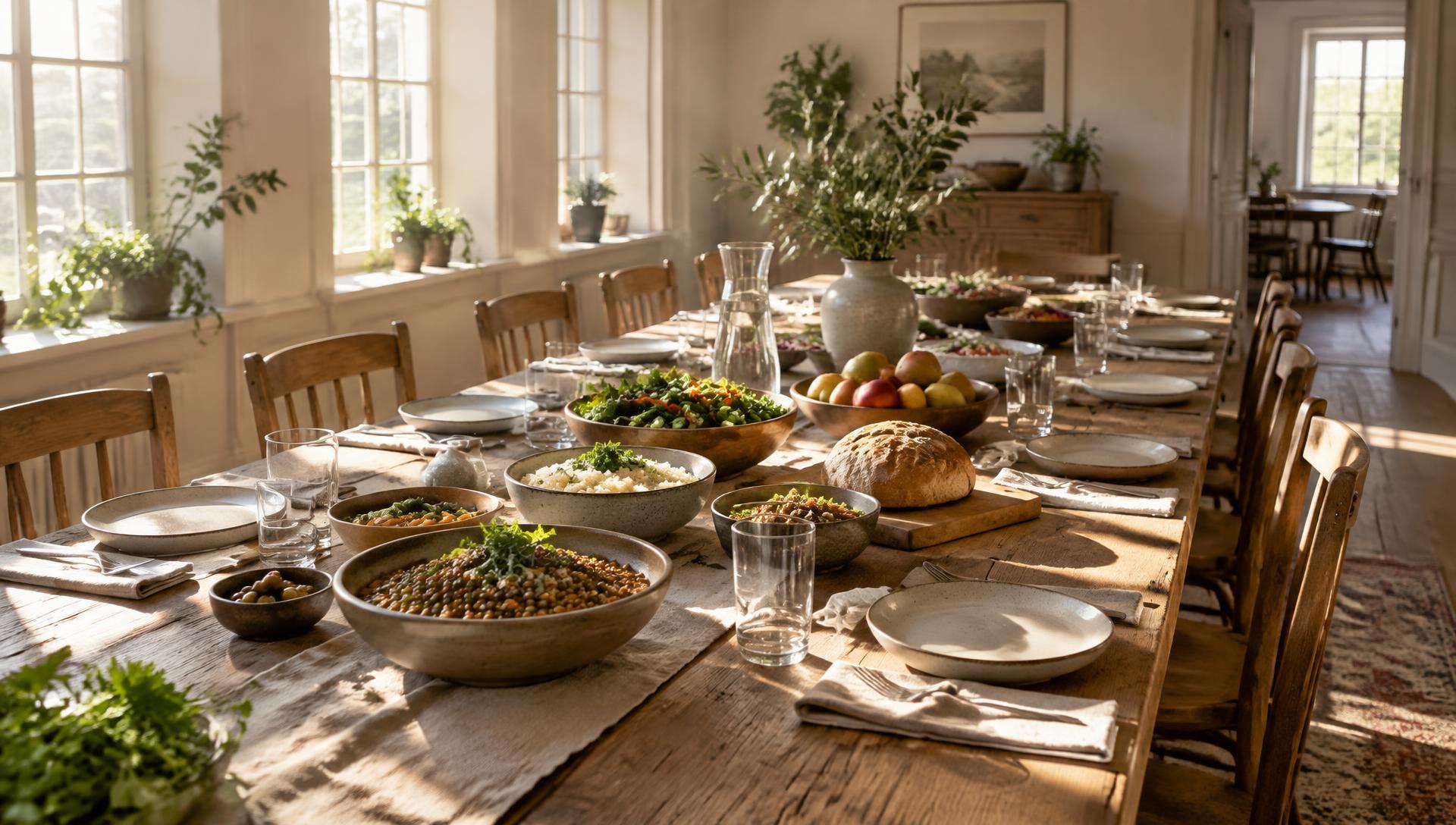
- Vegan Meeting-wide dinners are recommended as a primary way to reach hearts through stomachs.
- Vegan chocolate (honoring the legacy of the Fry family).
- Plant-based potluck dishes for Quarterly and Yearly Meetings.
- Fruits and vegetables as 'Rainbows of flowers, and fruits that meet our needs' (Canticle of Creation).
- Meatless Monday recipes shared in Meeting newsletters.
- Plant-based versions of traditional Quaker simple meals.
- Quaker potlucks often emphasize simple, wholesome grains and seasonal vegetables, reflecting the Testimony of Simplicity.
- Vegan 'Meeting-wide dinners' are recommended as a way to reach hearts through the stomach, showing that compassionate eating is abundant and joyful.
- Traditional chocolate-making families like the Frys have a history of philanthropy; modern Friends can honor this by choosing fair-trade, vegan cocoa products.
- The 'Canticle of Creation' celebrates fruits and seeds as the intended gifts for our needs, supporting a diet centered on the earth's natural bounty.
Action
What a community can do
- 1Give vegan dinners regularly at the Meeting, inviting the whole community with RSVPs.
- 2Make a brochure or booklet summarizing issues surrounding Animal Concern for your Meeting.
- 3Create a Meeting cookbook featuring vegan recipes contributed by Friends.
- 4Show films like 'A Prayer for Compassion' or 'A Life Connected' followed by discussion.
- 5Place vegan children's books and adult literature in the Meeting library.
- 6Write letters and articles for Friends' periodicals regarding animal compassion.
- 7Propose a Meeting minute urging awareness of the suffering of animals and the Planet.
- 8Encourage family outings like hiking or sanctuary visits instead of fishing or zoos.
- 9Urge the Meeting to buy planet- and animal-friendly cleaning supplies and paper.
- 10Encourage families to participate in Meatless Mondays.
- 11Review vegan books and articles in the Meeting newsletter.
- 12Host a visit to a local animal sanctuary.
- 13Transition Meeting-wide dinners slowly toward being fully vegan.
- 14Walk cheerfully, answering to 'That of God' in every living being.
- 15Review the Meeting library and add titles like 'Taking the Adventure' or 'Journeys of Compassion' to encourage communal study.
- 16Host a visit to a local animal sanctuary to help members connect with the individuals behind the 'animal concern.'
- 17Include vegan recipes and quotations on compassion in the Meeting newsletter to normalize plant-based choices.
- 18Propose a Meeting 'minute' that officially recognizes the suffering of animals and the importance of environmental stewardship.
- 19Switch Meeting house supplies, such as soap and paper products, to those that are animal-friendly and eco-conscious.
Resources
Read, watch, connect
Books
- Black Beauty — Anna Sewell
- Animal Machines — Ruth Harrison
- Enlarging Our Circle of Love — Margaret Fisher
- Taking the Adventure: Faith and Our Kinship with Animals — Gracia Fay Ellwood
- Are Animals Our Neighbors? — Animal Kinship Committee, Orange Grove Meeting
- Journeys of Compassion: 125 Years of Quaker Concern for Animals — Quaker Concern for Animals
- Living by Voices We Shall Never Hear: Seeing Animals Differently — Pauline Mitchell and Les Mitchell
- Living Among Meat Eaters — Carol J. Adams
Films & talks
- A Prayer for Compassion — A film by Thomas Jackson exploring the intersection of faith and animal rights.
- A Life Connected — A short, 11-minute powerful and feel-good video about the impact of our choices.
- Peaceable Kingdom — Available to watch free online; explores the relationship between humans and animals.
- The Witness — A documentary available for free online viewing.
- Cowspiracy / What the Health — Documentaries available on Netflix regarding environment and health.
- Earthlings — An intense video showing animal cruelty; requires fair warning for viewers.
Questions