Nondenominational & Spiritual
Overview
Nondenominational & Spiritual — and the animals
The non-denominational spiritual path emphasizes the Golden Rule of harmlessness and universal lovingkindness. This tradition recognizes that all creatures are part of a sacred kinship, deserving of respect and protection from exploitation. By aligning daily actions—specifically our food choices—with these spiritual values, we can foster a more peaceful and harmonious world.
Central to this perspective is the understanding that the violence we commit against animals for food is an underlying cause of human conflict. Transitioning to a plant-based diet is viewed not just as a health or environmental choice, but as a profound spiritual practice that honors the right of all animals to live their own lives free from violence. It is a call to extend our circle of compassion to include every living thing.
This movement encourages spiritual communities to become 'guardians' rather than 'owners' of the natural world. By fostering education, nonviolent recreation, and cruelty-free communal meals, spiritual groups can lead the way in social justice and ecological sustainability, proving that slaughter and justice cannot dwell together.
Principles
Teachings that point towards the plate
Universal Lovingkindness
The core spiritual ideal is to bring the Golden Rule into alignment with everyday practices, ensuring that our interactions with all beings reflect a heart of compassion.
Kinship with All Creatures
Recognizing animals as fellow beings rather than objects, this principle encourages using language like 'guardian' and 'he/she' to honor their inherent dignity.
The Peace Connection
Spiritual peace is intrinsically linked to how we treat animals; as long as there are slaughterhouses, there will be battlefields in the human realm.
Ecological Stewardship
Choosing plant-based living is an act of stewardship for the Earth, using fewer resources and protecting the environment for the global human family.
Intersectionality of Justice
Animal rights are viewed as a vital component of the broader social justice movement, connected to human rights and environmental protection.
Nonviolent Living
Spirituality calls for the removal of harm from all aspects of life, from the products we buy to the entertainment we choose and the way we manage pests.
““Slaughter and justice cannot dwell together.””
““As long as there are slaughterhouses, there will be battlefields.””
““Until he extends the circle of compassion to all living things, man will not himself find peace.””
““We cannot have peace among men whose hearts delight in killing any living creature.””
““We are the living graves of murdered beasts, slaughtered to satisfy our appetites.””
““For as long as men massacre animals, they will kill each other.””
““The human cycle of violence will not stop until we stop the underlying violence, the remorseless violence we commit against animals for food.””
““The destruction of life will continue to repeat its psychology... until men willingly observe the law in all phases of life, 'Thou shalt not kill.'””
In practice
The Ten Steps to Community Alignment
Transforming a spiritual community begins with small, intentional steps that bridge the gap between ideals and actions. These steps can be introduced gradually to help the community evolve its mission toward total harmlessness.
Key initiatives include integrating animals into weekly prayers, updating mission statements to reflect kinship with all creatures, and adopting humane policies for interacting with local wildlife and insects.
- Include weekly prayers or intentions for animals.
- Use 'guardian' instead of 'owner' and 'he/she' instead of 'it'.
- Develop humane policies for removing insects and protecting birds from windows.
- Host educational films, speakers, and book studies on veganism.
- Choose nonviolent outings like hiking and canoeing over zoos or hunting.
- Request that members refrain from wearing fur in meeting areas.
- Purchase cruelty-free, fair-trade, and sustainable cleaning and paper products.
- Form a dedicated Vegan Spirituality group within the community.
- Sponsor only cruelty-free, plant-based communal meals.
- Work toward a 'Vegan Friendly' designation from the Interfaith Vegan Coalition.
In practice
The Spiritual Logic of Plant-Based Meals
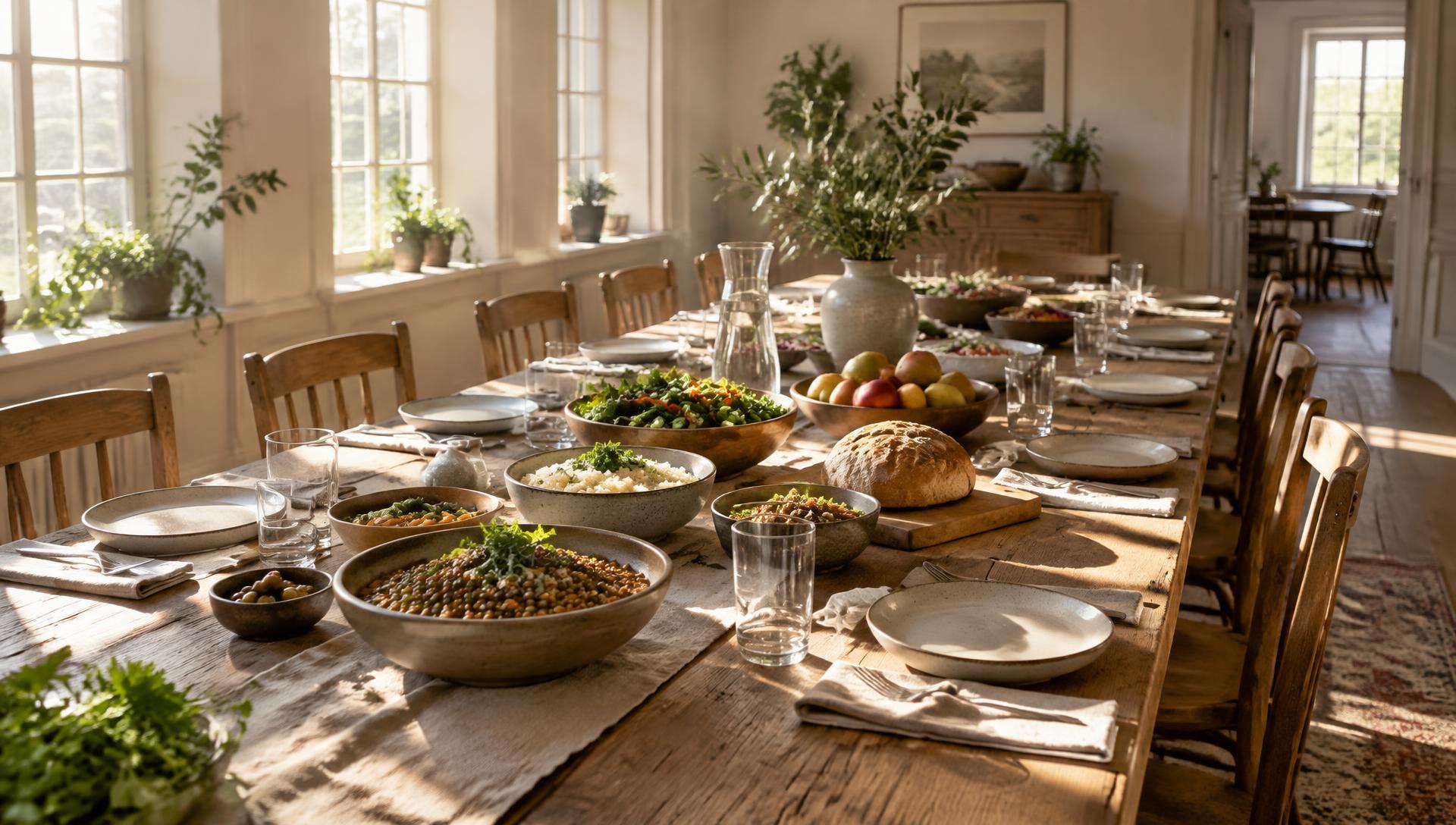
Sponsoring plant-based meals is perhaps the most dramatic message of compassion a spiritual group can send. It acknowledges a commitment to physical health, the health of the Earth, and the rights of the hungry.
Sharing these meals signifies respect for members already committed to veganism and serves as a practical application of the spiritual law 'Thou shalt not kill' in all phases of life.
In practice
Activism and Community Engagement
Spiritual leaders and members can collaborate to change perceptions through storytelling and education. Sharing personal testimonies about the transition to veganism can inspire others to reflect on their own choices.
Utilizing modern platforms like social media to share recipes and health information, or organizing field trips to animal sanctuaries, helps ground abstract spiritual concepts in real-world experiences.
In practice
The Universal Golden Rule and Kinship
The spiritual foundation for veganism in nondenominational settings is the expansion of the Golden Rule. While often applied to human interactions, spiritual wisdom suggests that true harmlessness (ahimsa) requires extending this empathy to all sentient life. By recognizing that animals share the same capacity for joy, fear, and family bonds, we align our daily habits with the universal vibration of love.
This perspective views animals not as resources or 'its,' but as fellow travelers on a spiritual journey. When we shift our language to refer to them as 'he' or 'she' and see ourselves as 'guardians' rather than 'owners,' we dismantle the spiritual hierarchy that leads to exploitation. This shift in consciousness is a form of prayer in action, honoring the divine spark within every living creature.
- Adopting the language of 'guardianship' to reflect spiritual responsibility.
- Recognizing the 'divine spark' or life force present in all sentient beings.
- Practicing 'ahimsa' or non-harming as a primary spiritual discipline.
In practice
Interconnectedness and the Environment
Many spiritual traditions emphasize the stewardship of the Earth as a sacred duty. Modern plant-based living is a direct response to the ecological crisis, as animal agriculture is a leading cause of habitat destruction and resource depletion. Choosing plant-based foods is a way to honor the 'Carbon Dharma,' recognizing that our personal choices affect the global climate and the survival of all species.
By reducing our ecological footprint, we practice a form of 'Carbon Yoga,' where our physical discipline serves a higher purpose of planetary healing. This approach views the Earth as a living system where the health of the soil, the water, and the animals are inextricably linked to our own spiritual well-being.
In practice
The Ethics of Material Goods
A spiritual life seeks consistency between inner values and outer manifestations. This extends beyond the plate to the materials we wear and use in our sacred spaces. Avoiding fur, leather, and silk is a way to ensure that our comfort does not come at the cost of another's life or suffering. In spiritual communities, this creates an atmosphere of pure intention, where no violence is brought into the sanctuary.
Choosing cruelty-free and ecologically sustainable cleaning products, candles, and paper is another way to practice mindfulness. When a community commits to purchasing only fair-trade and certified cruelty-free items, it sends a powerful message that every transaction is an opportunity to express compassion and justice.
In practice
Social Justice and Intersectionality
The movement for animal rights is deeply connected to other social justice movements. Spiritual communities often focus on the 'hungry of the world,' and a plant-based diet is a practical solution to global food insecurity, as it uses far fewer resources than an animal-based diet. By eating lower on the food chain, we leave more for others, practicing a form of global equity.
True peace cannot be achieved while we tolerate violence against any group. As many spiritual thinkers have noted, the psychology of killing animals often spills over into human conflict. By fostering a culture of nonviolence toward animals, we lay the psychological and spiritual groundwork for a more peaceful and just human society.
In practice
Spiritual Health and the Body
Many spiritual paths view the body as a temple or a vessel for the spirit. Nourishing this vessel with clean, plant-based foods is seen as a way to maintain clarity of mind and purity of heart. When we consume products of violence, we may inadvertently take on the energy of fear and suffering that the animals experienced.
Transitioning to a vegan lifestyle is often described as a 'metamorphosis' of the self. It allows for a deeper connection to one's intuition and a sense of lightness, as the physical body is no longer burdened by the heavy environmental and ethical toll of animal products. This physical health supports a more robust and focused spiritual practice.
In practice
Communicating with Compassion
When introducing these concepts to a spiritual community, it is vital to speak from a place of 'Universal Lovingkindness.' Rather than judging others, we share our own testimonies of how veganism has deepened our spiritual lives. This 'gentle advocacy' invites others into a circle of compassion rather than pushing them away with criticism.
Using films, book studies, and guest speakers can provide a neutral ground for education. By focusing on shared values—such as peace, health, and stewardship—we can find common ground with those who may not yet have considered the animal connection. The goal is to build a 'Green' committee that works collaboratively to align the community's high ideals with its everyday practices.
Food
Plant-based food in this tradition
- Vegan ice cream for community socials.
- Plant-based potluck dishes for study groups.
- Cruelty-free communal meals replacing animal products.
- Plant-based recipes shared via community social media.
- Sustainable and fair-trade food sourcing.
- Cooking demonstrations for plant-based meals.
- Plant-based potlucks are a staple of spiritual communities, allowing members to share recipes that nourish both body and soul.
- Traditional 'Breaking of Bread' can be honored with organic, stone-ground grains that celebrate the earth's bounty without animal fats.
- During times of fasting or spiritual retreat, plant-based whole foods are often preferred for their ability to maintain mental clarity and physical lightness.
- Festivals can be celebrated with 'cruelty-free' versions of traditional dishes, ensuring that the joy of the occasion does not stem from another's suffering.
Action
What a community can do
- 1Join the Worldwide Prayer Circle for Animals.
- 2Form a 'Green' committee to promote harmlessness.
- 3Host a vegan ice cream social with donated coupons.
- 4Organize a vegan potluck with a documentary screening.
- 5Write a letter to your spiritual leader suggesting animal-friendly initiatives.
- 6Share your vegan testimony during community sharing time.
- 7Offer to teach a plant-based cooking class.
- 8Plan a field trip to a local animal sanctuary.
- 9Distribute educational flyers from the Christian Vegetarian Association or similar groups.
- 10Donate prayer flags for animals to your place of worship.
- 11Participate in National Animal Rights Day events.
- 12Join monthly Vegan Spirituality conference calls.
- 13Adopt 'cruelty-free' purchasing for all community supplies.
- 14Remove fur products from spiritual meeting spaces.
- 15Join the Worldwide Prayer Circle for Animals to synchronize intentions with others globally.
- 16Host a 'Vegan Ice Cream Social' to demonstrate that compassionate living is joyful and delicious.
- 17Install bird-safe decals on large windows of meeting halls to prevent collisions.
- 18Create a 'Peace Garden' on community grounds that provides habitat for local wildlife and insects.
- 19Organize field trips to local animal sanctuaries to foster direct kinship with rescued animals.
Resources
Read, watch, connect
Books
- An Unnatural Order: The Roots of Our Destruction of Nature — Jim Mason
- Carbon Dharma: The Occupation of Butterflies — Sailesh Rao
- Carbon Yoga: The Vegan Metamorphosis — Sailesh Rao
- Peace to All Beings — Judy Carman
- The Missing Peace: The Hidden Power of our Kinship with Animals — Judy Carman
- A Plea for the Animals — Matthieu Ricard
- World Peace Diet — Will Tuttle, Ph.D
Films & talks
- A Life Connected — A short, powerful 11-minute video about our connection to all life.
- A Prayer for Compassion — Documentary by Thomas Jackson exploring spirituality and veganism.
- Earthlings — An intense documentary on animal cruelty; requires fair warning for viewers.
- Cowspiracy / What the Health — Documentaries focusing on environment and health, available on Netflix.
- Forks Over Knives — Focuses on the health benefits of a plant-based diet.
- The Metaphysics of Food — A talk by Will Tuttle on the spiritual implications of our diet.
- Songs for Animals, People, and the Earth — Album by Daniel Redwood.
Questions